
Participants in the western suburbs around Nerang, Mudgeeraba and Worongary, who are off the light rail line and rely entirely on buses or a car.
Registered NDIS Provider · 405 358 3296
NDIS Provider on the Gold Coast
Including the northern corridor most providers quietly skip.
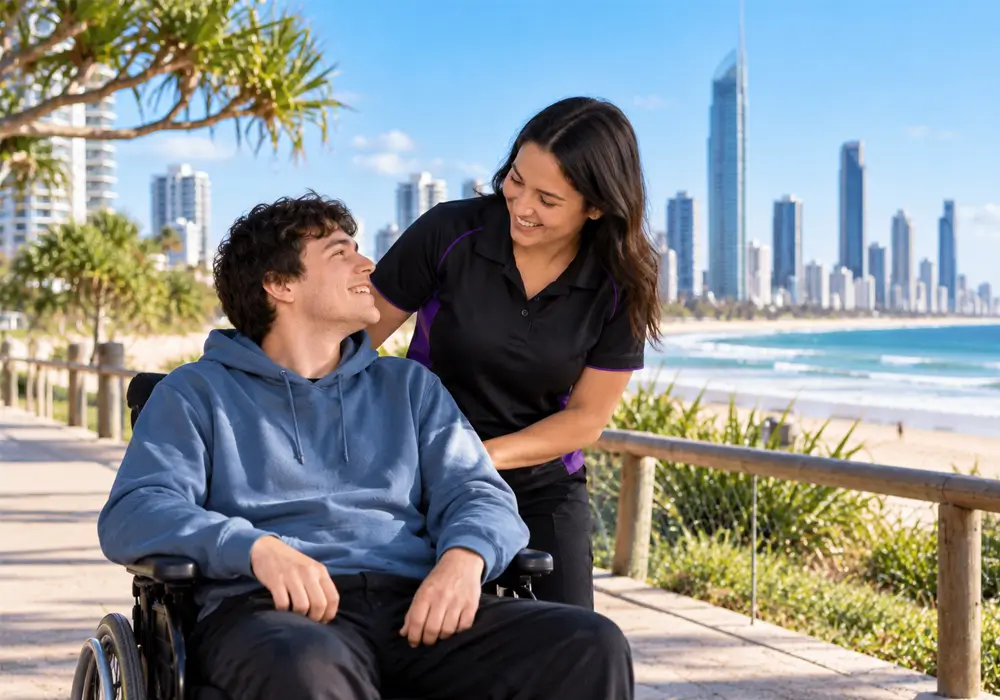
A registered provider covering the whole coast
GOTLEHS CARE is a registered NDIS provider, number 405 358 3296, based at Park Ridge. That location puts us closer to the northern Gold Coast than most Gold Coast providers are, which matters more than it sounds.
The Gold Coast runs close to sixty kilometres from Ormeau down to Coolangatta, and providers cluster hard around Southport, Robina and Nerang. Participants at either end find their options thin out quickly.
We cover Ormeau, Pimpama, Coomera, Upper Coomera, Helensvale, Southport, Nerang, Robina, Burleigh, Mudgeeraba, Palm Beach and down to Coolangatta.
NDIS services we deliver on the Gold Coast
All ten registered supports are available across the Gold Coast. Three come up most often.
Transport, because a sixty kilometre strip with a tram serving only the coastal spine leaves the western suburbs heavily car dependent. Social and community participation, because the Gold Coast has genuinely good community infrastructure if someone helps you find the parts of it that aren’t aimed at tourists. And personal care, particularly in the northern corridor where morning availability is hardest to secure.
Also available: accommodation and tenancy assistance, assist life stages and transition, daily living skills, physical wellbeing activities, therapeutic supports, specialised driver training, and assistance animals and innovative supports.
Accommodation and Tenancy Assistance
Assist Life Stages, Transition and Support
Assist Personal Activities
Assist Travel and Transport
Development of Daily Living and Life Skills
Physical Wellbeing Activities
Social and Community Participation
Therapeutic Supports
Specialised Driver Training
Assistance Animals and Other Innovative Supports
Who we support on the Gold Coast
Families in the northern growth corridor at Pimpama, Coomera and Upper Coomera, where the population has grown quickly and services have not.
People in the central strip from Southport to Broadbeach, where providers are plentiful and availability at useful hours still isn’t guaranteed.
Participants in the far south around Palm Beach, Currumbin and Coolangatta, who face the same thinning of options as the far north does.
And people whose community life is built around being outdoors, which on the Gold Coast is most people, and who need support to keep that going rather than to replace it with a program in a room.
How support works on the Gold Coast
-
We plan around the geography honestly. A worker cannot cover Ormeau and Coolangatta in the same day in any useful way, so we don’t pretend they can. Workers are allocated by section of the coast.
-
We build in the seasonal reality. Over summer and through school holidays, coastal traffic turns a twenty minute run into an hour, and a plan that only works in February is not a plan.
-
For community participation we lean on the outdoor options, because that’s where the Gold Coast is strongest and where a participant is most likely to find something that lasts. Beach access, parks, walking paths, surf clubs, community sport.
-
And we’re specific about morning coverage in the north. Early personal care shifts at Pimpama and Coomera are the hardest thing to staff on the coast, and we’d rather tell you what we can guarantee than promise a 7am slot we’ll be renegotiating in a month.
The problems Gold Coast participants face
The length of the city is the root of most of it. A support worker booked for a two hour shift can spend nearly as long in the car getting there and back, which makes the far ends of the coast unattractive to providers based in the middle.
The northern corridor gets skipped as a result. Ormeau, Pimpama and Coomera participants are often quoted longer waits and higher travel charges than someone in Robina with an identical plan.
The light rail only serves the coastal strip, so participants in Nerang, Mudgeeraba and the western suburbs have a substantially harder time getting anywhere without a car.
Seasonal traffic disrupts routines for months at a time, and participants who depend on scheduled community access find their week becomes unreliable through summer.
And housing pressure on the coast is severe, which shows up as participants moving frequently, losing continuity of support each time, and sometimes moving inland to areas where their supports can’t follow.
What we do about it on the Gold Coast
We treat the northern corridor as a priority rather than an outer run. Being based at Park Ridge, Ormeau and Pimpama are closer to us than they are to a provider operating out of Robina, and our travel charges reflect that.
We allocate workers by section of the coast so travel stays proportionate and shifts start when they’re meant to.
We plan for summer before summer, adjusting timings on the routes that become unreliable rather than watching a routine collapse in December.
Where a participant moves, which happens often on the coast, we work to keep the same worker with them. If someone moves north into Logan, that’s still our area, which is an advantage a coast-only provider doesn’t have.
And we’re honest about the far south. Coolangatta and Currumbin are the edge of what we can cover reliably, and we’ll tell you what that means for your hours before you commit to us.

Talk to us about supports on the Gold Coast
Tell us where on the coast you are and what hours you need. Ring 0425 799 687 between 9am and 5pm Monday to Friday, or email info@gotlehscare.com.au.
Frequently asked questions
If your question isn’t here, ring us on 0425 799 687. We’d rather answer it properly than have you guess.
Do you cover the northern Gold Coast?
Yes, and it’s one of our stronger areas. Ormeau, Pimpama, Coomera and Upper Coomera are closer to our Park Ridge base than they are to most Gold Coast providers, which shows up in both availability and travel charges.
How far south do you go?
Down to Coolangatta, though the far south is the edge of what we can cover reliably. We’ll tell you honestly what that means for the specific hours you need rather than committing to something we’d be renegotiating later.
Do you service the western suburbs like Nerang and Mudgeeraba?
Yes. These areas sit off the light rail line and are heavily car dependent, which makes transport support particularly useful there.
Does holiday traffic affect my supports?
It can, and we plan for it rather than reacting to it. Coastal traffic over summer and school holidays turns short runs into long ones, so timings on the affected routes get adjusted in advance.
What happens if I move house?
We work to keep the same worker with you. If you move north into Logan that’s still our area, which is an advantage a coast-only provider can’t offer. Housing moves are common here and continuity through them matters.