Aboriginal and Torres Strait Islander participants, who make up a substantial proportion of the Far North Queensland population. Culturally safe support here means understanding family and community structures, respecting how decisions are actually made, and not assuming a service model designed in a capital city transfers unchanged.
Registered NDIS Provider · 405 358 3296
NDIS Provider in Cairns, Far North Queensland
Local workers, local rosters, and an honest answer about what we can cover.
How we work in Cairns
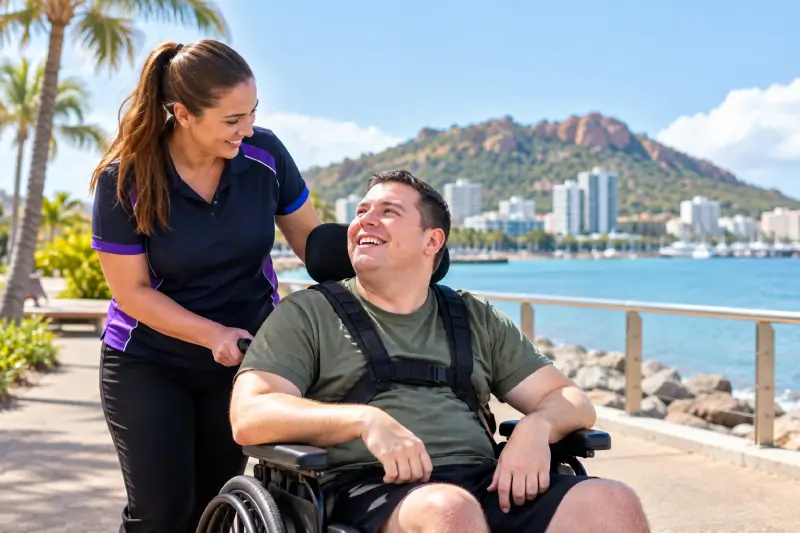
Cairns is around 1,700 kilometres from our head office at Park Ridge. There is no version of this where a worker drives up for a shift, so our Cairns supports are delivered entirely by people who live in Far North Queensland.
We say that plainly because participants here have heard the alternative too many times. A provider lists Cairns on a coverage map, accepts the referral, and then the shifts never materialise. That pattern has cost people months.
GOTLEHS CARE is a registered NDIS provider, number 405 358 3296, audited against the NDIS Practice Standards. We can invoice agency-managed plans as well as plan-managed and self-managed ones. In a region with few registered providers, that matters more than it does in a capital city.
We cover Cairns city and the suburbs, including Manunda, Manoora, Westcourt, Earlville, Woree, Bentley Park, Mount Sheridan, Edmonton and Gordonvale to the south, and Freshwater, Brinsmead, Redlynch, Smithfield, Trinity Beach, Clifton Beach and Palm Cove to the north.
NDIS services we deliver in Cairns
All ten of our registered supports are available in Cairns. Four are requested most often here.
Transport, because the region is long and thin and public transport thins out fast once you leave the main corridor. Personal care, rostered consistently rather than filled by whoever is available. Social and community participation, built around what a participant actually wants to do locally. And therapeutic supports, coordinated so that the small amount of allied health available in the region actually produces something.
The rest are equally available: accommodation and tenancy assistance, assist life stages and transition, daily living and life skills, physical wellbeing activities, specialised driver training, and assistance animals and innovative supports.
Accommodation and Tenancy Assistance
Assist Life Stages, Transition and Support
Assist Personal Activities
Assist Travel and Transport
Development of Daily Living and Life Skills
Physical Wellbeing Activities
Social and Community Participation
Therapeutic Supports
Specialised Driver Training
Assistance Animals and Other Innovative Supports
Who we support in Cairns
Participants across the Cairns urban area, from Gordonvale in the south to the northern beaches, of all ages and all disability types.
Participants on the Atherton Tablelands, in Atherton, Mareeba, Kuranda, Yungaburra and Malanda, where the range drive means the coast is further away than the kilometres suggest.
People in the southern corridor around Innisfail and Babinda, and to the north around Mossman and Port Douglas, who rely on Cairns as their service centre.
Participants attending Cairns Hospital, including those travelling down from Cape York and across from the Torres Strait for care, and those who need supports in place before they head home again.
And school leavers across the region's high schools, where post-school options are far fewer than in the south and the planning needs to start earlier as a result.
How support works in Cairns
-
Geography drives the roster. Cairns is a narrow strip between the ranges and the sea, and a run from Palm Cove to Gordonvale is most of an hour without traffic. We assign workers to the northern beaches, the city, and the southern corridor rather than sending people end to end and billing a participant for the drive.
-
For Tablelands participants we structure supports as fewer, longer shifts. The Kuranda and Gillies ranges are the same climb whether a worker is coming for one hour or four, so a single block achieves far more per dollar than three short visits.
-
We plan for the wet season properly, because in Far North Queensland it is not a minor inconvenience. Between November and April the Bruce Highway can close south of Cairns, Tablelands roads become unreliable, and a support plan with no wet weather version is a support plan that stops working for a third of the year.
-
Heat and humidity shape the timetable too. Community and outdoor supports go in the early morning or late afternoon, and anything scheduled for midday in the build-up is a shift that will not be completed.
-
And we work hard on carryover from therapy. Allied health is scarcer here than anywhere else we operate, so when a participant does get a session, the strategies that come out of it need to be applied every day afterwards, not filed away until the next appointment months later.
The problems Cairns participants face
The provider shortage is the most severe in our footprint. Participants frequently cannot find anyone to deliver a funded support, which is a different problem entirely to choosing between options.
Allied health barely exists in some disciplines. Waits run long, some subspecialties have no local presence, and families travel to Townsville or Brisbane for assessments, which means flights, accommodation and a serious share of a plan spent on getting to a one hour appointment.
Distance in every direction. The Tablelands are up a range, Cape York is a different world again, and the Torres Strait involves a flight. Services designed for a city do not map onto this.
Wet season disruption that affects entire months, not individual days, and is far more consequential here than in the south east.
Cultural safety failures. Participants describe services delivered by people with no understanding of community or family obligations, decisions pushed onto individuals in a context where that isn't how decisions get made, and support plans that quietly assume a household structure that doesn't apply.
And plan funding that doesn't reflect regional reality. Plans are often built on metropolitan assumptions about travel and availability, then don't stretch, because everything here takes longer and costs more to reach.
What we do about it in Cairns
Local workers only. We don't take on a shift we can't staff from within the region, and we'd rather say no on the first call than add someone to a list that was never going to move.
We assign by section of the region, north, city and south, so travel time stays proportionate and participants aren't paying for a worker to cross the whole strip.
Tablelands supports are structured as longer blocks, which converts range travel into support hours instead of wasted funding.
Every plan gets a wet season version agreed before November, covering what changes when roads close and who does what.
We treat cultural safety as a working requirement, not a policy statement. That means asking how decisions are made in a participant's family rather than assuming, working with community where community is part of the picture, and being honest when we can't provide an appropriate match rather than sending someone unsuitable.
And we help participants document regional costs properly at plan reassessment, because a plan written on southern travel assumptions will not survive a Far North Queensland year.
Talk to us about supports in Cairns
Tell us where you are and what you need, and you'll get an honest answer about our capacity, including if the answer is no. Ring 0425 799 687 between 9am and 5pm Monday to Friday, or email info@gotlehscare.com.au.
Frequently asked questions
If your question isn't here, ring us on 0425 799 687. We'd rather answer it properly than have you guess.
Are your Cairns support workers based in Far North Queensland?
Yes, entirely. Our head office is at Park Ridge, around 1,700 kilometres south, so there is no version of this where someone drives up for a shift. Every Cairns support is delivered by a worker who lives in the region, and if we can't staff it locally we don't take it on.
Do you cover the Atherton Tablelands?
Yes, including Atherton, Mareeba, Kuranda, Yungaburra and Malanda. We structure Tablelands supports as fewer, longer shifts, because the range drive is the same whether a worker comes for one hour or four, and a longer block puts far more of your funding into actual support.
How do you approach culturally safe support?
As a working requirement rather than a policy line. That means asking how decisions are made in your family and community rather than assuming, working with community where that's part of the picture, and telling you honestly when we can't provide an appropriate worker match instead of sending someone unsuitable.
What happens to my supports during the wet season?
We agree a wet season version of your plan before November, covering what changes when roads close and who does what. In Far North Queensland the wet affects whole months rather than individual days, so it needs planning rather than improvising.
My plan funding doesn't stretch up here. Can you help?
It's a common problem, because plans are often built on metropolitan assumptions about travel time and provider availability. We can help you document the actual regional costs ahead of a plan reassessment, which is far more persuasive than describing the situation in general terms.